Español
 Español
Español
By Javier Zevallos | Vanguard Minerals Insights
Salt is one of the world’s oldest and most familiar ingredients. Yet behind something as simple as a pinch of salt is a story shaped by source, geology, processing, and mineral composition.
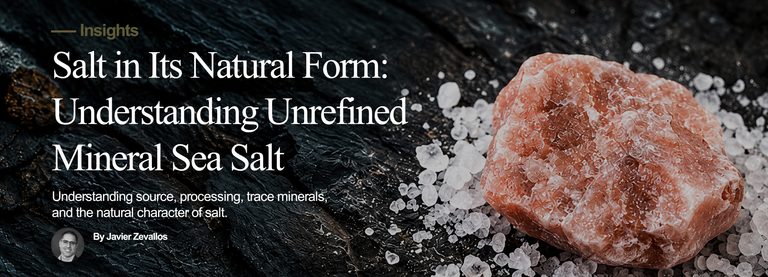
At its foundation, salt is sodium chloride (NaCl), an essential nutrient that has been used by people for thousands of years. Salt can come from several natural sources, including modern seawater and underground deposits formed from ancient seabeds. Understanding those differences is a useful first step in understanding what makes an unrefined mineral sea salt distinctive.

Not all salt reaches the kitchen in the same way. Conventional table salt is generally processed to create a consistent color, texture, and crystal size, and some products include added iodine or anti-caking agents.
Unrefined mineral sea salt takes a simpler approach. Minimal processing allows more of the salt’s natural characteristics to remain, including subtle variations in color, grain, and naturally occurring mineral composition. Those differences are part of the story of where the salt comes from and how it reaches the table.
When I look at salt, I find three questions especially useful: Where does it come from? How is it harvested? How is it processed?
The mineral sea salt offered by Vanguard Minerals originates from an ancient sea deposit in central Utah. Its natural mineral profile includes more than 60 naturally occurring trace elements, reflecting the geological character of its source.
Those trace elements are not a reason to treat salt as a nutritional supplement. Rather, they help illustrate the natural composition of an unrefined mineral resource and what differentiates it from a highly standardized refined salt.
Ultimately, the value of a culinary salt is experienced in the kitchen. Fine-grain mineral salt dissolves quickly and evenly, making it versatile for everyday cooking, baking, table seasoning, and finishing. A larger kosher grain is easier to pinch and distribute by hand, providing greater control when seasoning meats, vegetables, and foods prepared on the grill.
Different grains serve different purposes, while sharing the same naturally unrefined mineral source.
For us at Vanguard Minerals, understanding salt begins with something simple: know the source, understand the process, and appreciate the natural character of the mineral.